
are all cryptocurrencies the same
Are all cryptocurrencies the same
Let’s take Bitcoin mining as an example. Suppose you own a Bitcoin ASIC miner that has a hash rate of 100 TH/s (terahashes per second). If the current difficulty is 22 https://portal-credo.info/.68 trillion and the block reward is 6.25 BTC, we can calculate your potential earnings.
As we’ve seen, miners must hash the block header repeatedly using different nonce values. They do so until they find a valid block hash. When a miner finds a valid block hash, they broadcast this block to the network. Then, all other validating nodes will check if the block is valid and, if so, add the new block to their copy of the blockchain.
Although a maximum of 21 million bitcoins can be minted, it’s likely that the number of bitcoins circulating remains substantially below that number. Bitcoin holders can lose access to their bitcoins, such as by losing the private keys to their Bitcoin wallets or passing away without sharing their wallet details. A June 2020 study by the crypto forensics firm Chainalysis estimated that up to 20% of the Bitcoin already issued may be permanently lost.
Market cap of all cryptocurrencies
Welcome to CoinMarketCap.com! This site was founded in May 2013 by Brandon Chez to provide up-to-date cryptocurrency prices, charts and data about the emerging cryptocurrency markets. Since then, the world of blockchain and cryptocurrency has grown exponentially and we are very proud to have grown with it. We take our data very seriously and we do not change our data to fit any narrative: we stand for accurately, timely and unbiased information.
A blockchain is a type of distributed ledger that is useful for recording the transactions and balances of different participants. All transactions are stored in blocks, which are generated periodically and linked together with cryptographic methods. Once a block is added to the blockchain, data contained within it cannot be changed, unless all subsequent blocks are changed as well.
Even though market cap is a widely used metric, it can sometimes be misleading. A good rule of thumb is that the usefulness of any given cryptocurrency’s market cap metric increases in proportion with the cryptocurrency’s trading volume. If a cryptocurrency is actively traded and has deep liquidity across many different exchanges, it becomes much harder for single actors to manipulate prices and create an unrealistic market cap for the cryptocurrency.
Cryptocurrency works through networks of nodes that are constantly communicating with each other to stay updated about the current state of the ledger. With permissionless cryptocurrencies, a node can be operated by anyone, provided they have the necessary technical knowledge, computer hardware and bandwidth.
You can find historical crypto market cap and crypto price data on CoinCodex, a comprehensive platform for crypto charts and prices. After you find the cryptocurrency you’re interested in on CoinCodex, such as Bitcoin, head over to the “Historical” tab and you will be able to access a full overview of the coin’s price history. For any given coin, you will be able to select a custom time period, data frequency, and currency. The feature is free to use and you can also export the data if you want to analyze it further.
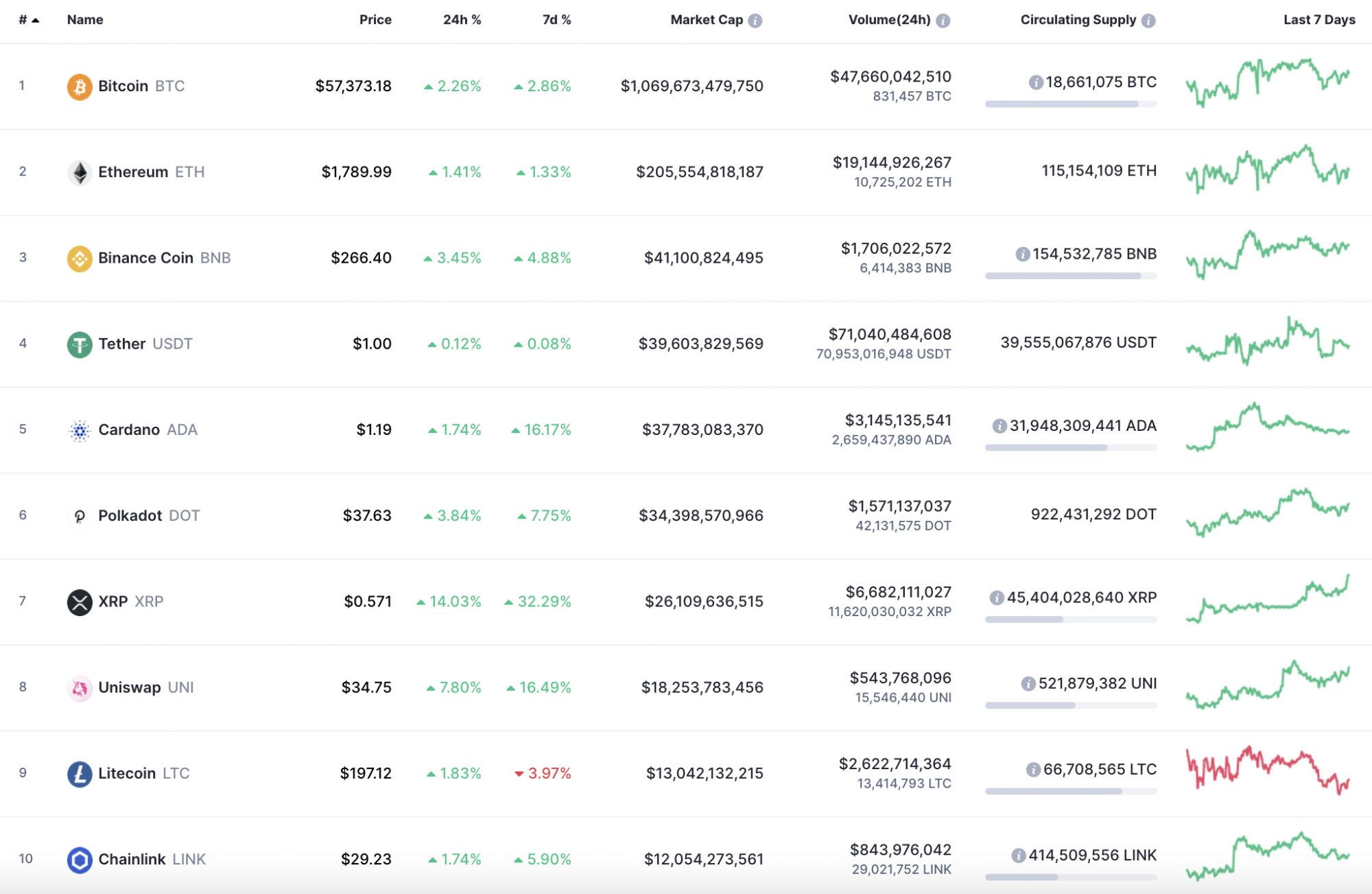
Are all cryptocurrencies based on blockchain
As we head into the third decade of blockchain, it’s no longer a question of if legacy companies will catch on to the technology—it’s a question of when. Today, we see a proliferation of NFTs and the tokenization of assets. Tomorrow, we may see a combination of blockchains, tokens, and artificial intelligence all incorporated into business and consumer solutions.
Some companies experimenting with blockchain include Walmart, Pfizer, AIG, Siemens, and Unilever, among others. For example, IBM has created its Food Trust blockchain to trace the journey that food products take to get to their locations.
Bitcoin was the first cryptocurrency to see the light of day, back in 2009. But it wasn’t the cryptocurrency alone that prompted such international interest. Many believe that the more important novelty was Bitcoin’s underlying blockchain technology. Introducing decentralized peer-to-peer blockchains, the technology took the world by storm. For a few years, blockchain ledgers were the defining characteristic of any cryptocurrency. But that all changed with the official launch of IOTA.
Some see DAGs as an alternative that combats the shortcomings of blockchain technology, but it would be false to claim that one technology is better than the other. In the world of cryptocurrency, people often try to build hype around the technology they invested in. This leads to the creation of buzzwords like “blockchain killer,” meant to portray DAGs as technologically superior to blockchain.